Omninetwork token migration converts OMNI to NOM at a 1:75 ratio
Last updated -
Omninetwork token migration converts OMNI to NOM at 1:75, with the required action depending on the tokens' network and custody. Self-custodied OMNI on Ethereum follows the manual migration path; exchange-held OMNI follows the exchange's arrangements. Nomina reported automatically converting Omni EVM holdings during the September 23, 2025 upgrade. It later reported moving Omni Core balances, staked positions and held assets to Ethereum after closing that chain on February 17, 2026. The published rebrand terms set no conversion deadline. These changes affect different properties of a holding: its token denomination, who handles conversion and the network where the resulting asset resides.
Network and Custody Determine the Migration Path
A self-custodied OMNI balance on Ethereum required a different conversion process from OMNI held on the Omni EVM or through an exchange. Ethereum L1 means Ethereum's base network, while the Omni EVM was the separate execution environment for Omni Core. Custody identifies who controls the holding. A wallet address alone does not describe both the network and the custody arrangement, and those distinctions determined the migration responsibility.
The Redenomination Changes Token Units
The rebrand changed the unit used to express a holding while retaining the previously outlined tokenomics structure. The OMNI-to-NOM redenomination rate is 1:75. For a selected OMNI amount, the corresponding NOM amount equals that amount multiplied by 75.
Omni's original token plan set a total supply of 100,000,000 OMNI. The rebrand announced 7,500,000,000 NOM as the total supply after redenomination. The project described the increase in token count as redenomination without newly introduced token supply. A larger number alone does not establish a change in the market value of a holding. Market prices and transaction costs belong to a separate value calculation.
Ethereum NOM Uses a Specific Token Contract
Ethereum NOM is an ERC-20 token identified by its contract, alongside the Ethereum network and the NOM ticker. The rebrand announcement identified
0x6e6F6d696e61decd6605bD4a57836c5DB6923340
as the NOM contract. A ticker is a short display label; the contract identifies the token instance on that network. This distinction helps interpret wallet displays after migration, because a matching name alone cannot establish the asset's identity.
Self-Custodied OMNI and the Selected Upgrade Amount
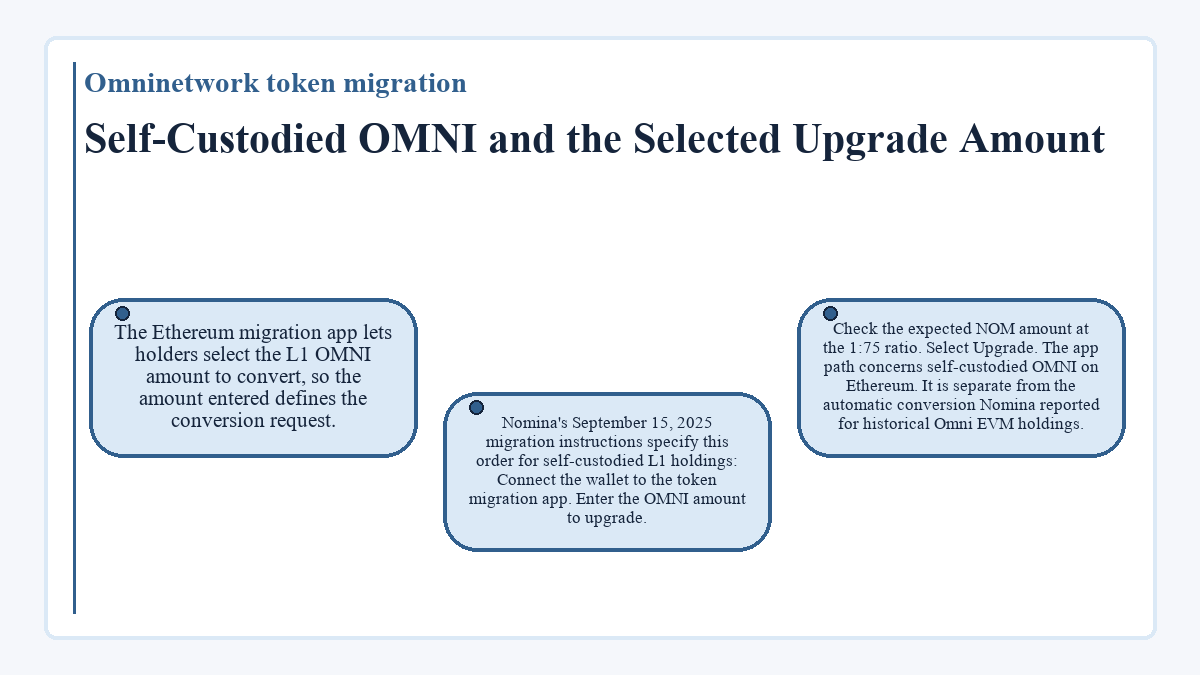
The Ethereum migration app lets holders select the L1 OMNI amount to convert, so the amount entered defines the conversion request.
Nomina's September 15, 2025 migration instructions specify this order for self-custodied L1 holdings:
- Connect the wallet to the token migration app.
- Enter the OMNI amount to upgrade.
- Check the expected NOM amount at the 1:75 ratio.
- Select Upgrade.
The app path concerns self-custodied OMNI on Ethereum. It is separate from the automatic conversion Nomina reported for historical Omni EVM holdings.
Gas Costs Follow Ethereum's Transaction Rules
Ethereum transactions pay for computation in ETH, so the network fee and the OMNI-to-NOM conversion amount measure different things. Ethereum gas prices vary with network demand and transaction settings. The number of tokens selected does not, by itself, determine the gas charge.
Ethereum Network Charges
Ethereum's execution fee equals gas used multiplied by the effective gas price. Under the base-fee and priority-fee system, that price combines the block's base fee with the effective tip. Prices commonly use gwei, where 1 gwei equals 0.000000001 ETH.
Successful Execution
A successful Ethereum transaction pays for the gas it uses. Its gas charge follows the executed computation rather than the number of NOM tokens in the output.
Reverted Execution
Ethereum charges for the work an included transaction performs even if execution reverts. A transaction rejected before inclusion consumes no execution gas.
Fee Estimates Before Execution
A wallet's estimate combines expected gas usage with fee assumptions. The final charge follows actual execution and the effective gas price. A higher gas limit permits more computation; it does not mean the transaction will use that entire allowance.
Exchanges Control Their Own Conversion Processing
Exchange-held OMNI followed the exchange-managed route described in Nomina's rebrand update, which left custody and account processing with the exchange. The update expected exchanges to migrate Ethereum-held OMNI in the following weeks. That language described a rollout expectation, not a completion announcement for every exchange or every customer's balance.
An account's credited asset and amount identify what its custodian has actually processed. The project's redenomination rate supplies the conversion relationship, but it does not supply a provider's processing date. A broad network announcement cannot establish whether an individual exchange has finished crediting a particular account.
Existing Omni EVM Holdings Converted Automatically
The September 23, 2025 network upgrade covered OMNI held on the Omni EVM, including staked OMNI and staking rewards, through automatic conversion to NOM. Nomina's rebrand update reported that upgrade as completed. Holding those assets on that network defined the automatic path; the update separately directed self-custodied Ethereum holders to the migration app.
Genesis Campaign Conditions
Nomina's September 15, 2025 instructions treated genesis staking separately. Participants in the boosted-rewards program would keep the campaign's original reward claim dates.
For genesis stakers outside the upgrade campaign, the guide stated that their L1 OMNI would return on L1 without automatic conversion.
The OMNI conversion terms concern OMNI-denominated balances, including native staking rewards within the specified scope. ETH principal in separate EigenLayer restaking positions belongs to a different asset and protocol context.
Omni Core's Closure Moved Chain Assets to Ethereum
Nomina's February 23, 2026 announcement reported that Omni Core's wallet balances, staked positions and held assets had migrated to Ethereum as ERC-20 tokens.
Omni Core closed on February 17, 2026. The announcement described the state migration as automatic, with no user action required. It concerned holdings on Omni Core, the project's original blockchain.
The two changes addressed different properties. The 2025 upgrade changed OMNI token units into NOM units on the Omni EVM. The 2026 state migration changed the location and representation of assets from the retired chain. The 1:75 rate belongs to the token redenomination.
Ethereum became the relevant network for the migrated token holdings. An old-chain balance display describes the retired network's state; it does not identify a current ERC-20 balance by itself.
The Rebrand Terms Set No Conversion Deadline
The OMNI-to-NOM rebrand terms explicitly left conversion open-ended, allowing holders to choose when to migrate. That window applied to the token conversion; it did not set a completion date for exchange processing or a general claim period for separate reward programs.
An open-ended conversion window does not fix Ethereum gas charges or make every provider operate on the same schedule. The automatic upgrades have their historical event dates, while a self-custodied Ethereum holder's conversion follows the manual path. Custody and network remain relevant even without a closing date.
Does a 1:75 Conversion Mean My NOM Came From Omni Core?
The 1:75 ratio alone cannot show whether NOM came from Omni Core, because manual Ethereum conversions and the automatic Omni EVM upgrade used the same rate.
Consider a hypothetical self-custodied Ethereum holding with 23.65 OMNI recorded as converted and 1,773.75 NOM recorded as received. Assume no other NOM transfers alter the comparison. The calculation is 23.65 × 75 = 1,773.75 NOM. The amounts match the published rate, and the holding remained on Ethereum throughout this conversion.
This case identifies an Ethereum OMNI-to-NOM conversion; it does not show that anything moved from Omni Core. The conclusion holds only while the records concern the same wallet, the selected conversion amount and the Ethereum NOM token. Other transfers or a different network would change what those balances establish.
Native Staking After the Token Conversion
The 2025 rebrand terms announced a pause in native OMNI staking and specified that NOM staking would be unavailable at launch. Automatic conversion addressed existing OMNI stakes and rewards on the Omni EVM. Those launch-stage terms did not create an immediately available NOM staking option.
The later Ethereum consolidation addressed asset migration from the retired chain. A converted ERC-20 balance represents a token holding on Ethereum, where transaction fees use ETH. Any later staking choice concerns a separate product's supported asset, network and withdrawal terms.
Omninetwork token migration: questions and answers
Did the Genesis airdrop's 45-Day Claim Window Limit the Token Migration?
The Genesis airdrop's claim window was separate from OMNI-to-NOM migration. The April 10, 2024 airdrop announcement gave eligible users 45 days from the opening of claims, not 45 days from the announcement. Unclaimed airdrop tokens would return to the Omni Foundation. That historical reward claim period did not replace the rebrand's open-ended conversion terms.
Why Is 21,000 Gas an Unsuitable Fixed Estimate for an OMNI Upgrade?
The 21,000-gas figure describes a standard ETH transfer, not a universal token-conversion cost. Ethereum charges for the computation a transaction actually performs. An OMNI migration estimate therefore needs the particular contract interaction and current fee environment; the token amount or 1:75 rate alone cannot determine the ETH charge.
Was 2.9 Billion NOM a Live circulating-supply Figure?
The 2.9 billion NOM figure described circulation at the 2025 rebrand launch. The announcement paired that launch figure with the new denomination; it was not a continuously updated supply reading. The migration's 1:75 conversion relationship therefore answers a different question from how many NOM tokens are circulating at a later date.
Could OMNI Continue to Exist After NOM Became the Network Token?
OMNI could continue existing under the September 2025 migration plan while NOM became the main network token. The old token's continued existence therefore does not establish that an individual conversion failed.
Can the Displayed NOM Quote Confirm That a Migration Has Finished?
A NOM quote gives the expected output; it does not confirm receipt of tokens. Connecting a wallet and entering an amount are preparatory actions. Completion concerns the actual conversion and resulting Ethereum NOM balance.