Omninetwork evolved from rollup messaging into Nomina's trading platform
Last updated -
Omninetwork became Nomina, shifting from rollup interoperability infrastructure toward a terminal for trading across perpetual futures decentralized exchanges. Its earlier work included Omni Core messaging and SolverNet, a system for requesting actions across blockchains. Nomina announced Omni Core's February 2026 closure and reported migrating chain balances and assets to Ethereum while concentrating development on the trading terminal.
The team announced the Nomina name on August 12, 2025 and described the trading terminal at its September 15 launch. A network upgrade followed on September 23. The February 2026 Core closure came later, separate from the rebrand and token redenomination.
What Happened to Omni Core?
Nomina's February 23, 2026 announcement reported Omni Core's shutdown on February 17, 2026. The announcement described the closure as complete and said wallet balances, staked positions and held assets had migrated automatically to Ethereum as ERC-20 tokens. This was a chain-state migration: existing holdings moved from the retired blockchain into token representations on Ethereum.
Nomina said users needed no action for that Core migration. This instruction covered holdings on the retiring chain. The earlier OMNI-to-NOM conversion also involved Ethereum holders and exchange balances, with separate handling for those locations.
Nomina's Coordinated Perpetuals Trading
Nomina's terminal coordinates strategies across integrated perpetual futures DEXs, bringing execution and monitoring into one interface. DEX means decentralized exchange. Perpetual futures are contracts without a scheduled expiry. The terminal includes pre-built strategies and tools for automating strategy configuration and unwinding.
A trade leg is one position within a strategy containing multiple positions. Nomina supports synchronized opening and closing of legs across DEXs. Its monitoring tools bring profit information and position health into a shared view, and the product describes a control for closing multi-exchange strategies together. These functions address different parts of running a strategy: execution establishes the positions, while monitoring follows their status after opening.
Those legs remain distinct positions even when the terminal groups their controls and monitoring.
Messaging, Intents and SolverNet's Developer Role
Omni's earlier interoperability work addressed communication and actions across Ethereum and its rollups. Cross-chain messages carry information between blockchains; intents describe outcomes a user requests. The December 2024 roadmap outlined both mechanisms, assigning messaging to Omni Core and developing SolverNet around intent execution.
Messaging and Intent Execution
Omni Core's Messaging Layer
Omni Core was the messaging component in the December 2024 roadmap. The plan described launch support for finalized settlement and faster sequencer confirmations. Those confirmation choices concerned when chain activity counted as confirmed for messaging. They belonged to the Core architecture, which later closed, and do not describe speed settings for Nomina's trading terminal.
SolverNet's Cross-Chain Requests
SolverNet targeted arbitrary actions across chains through an intent-based architecture. Application integrations aimed to let users deposit into protocols using tokens held on another chain. The December 2024 plan identified source-chain transaction inclusion as a latency constraint. It proposed an off-chain peer-to-peer mempool, a network distributing pending requests, to reduce that delay. Destination-chain finality would still constrain execution. The subsecond ambition belonged to this proposed architecture, not a universal completion promise for every cross-chain action. The roadmap also proposed permissionless solvers, permissionless protocol integrations and a TypeScript SDK for 2025.
Developer Tools at the Rebrand
The September 15, 2025 launch announcement said the SolverNet SDK would remain available to teams using it. An SDK is a software development kit developers integrate into applications. The launch identified Symbiotic and Cygnus as teams SolverNet had supported. The SDK represented application-integration work, while the terminal brought the project's product focus directly to traders.
How Did OMNI Become NOM?
OMNI became NOM through a token redenomination accompanying the 2025 rebrand. The announced conversion ratio was 1 OMNI to 75 NOM. A redenomination changes the unit count used to represent a token holding. It differs from the February 2026 relocation of Core holdings to Ethereum, which concerned the blockchain holding those assets.
The September 23, 2025 upgrade update said OMNI on the Omni EVM, including staking rewards, converted automatically. EVM means Ethereum Virtual Machine, the environment executing compatible blockchain code. The update assigned Ethereum OMNI held on exchanges to their respective exchange migration processes. It directed holders of self-held Ethereum OMNI to the migration app. Network and custody therefore determined which conversion path applied.
A Hypothetical OMNI Holding
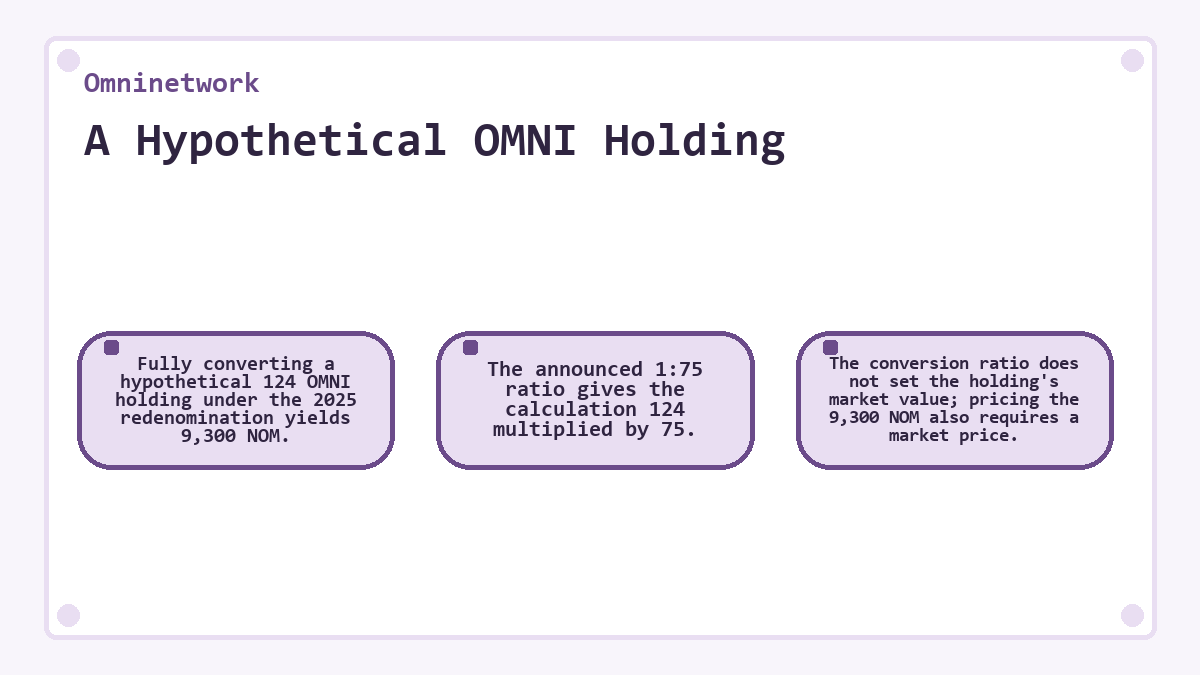
Fully converting a hypothetical 124 OMNI holding under the 2025 redenomination yields 9,300 NOM. The announced 1:75 ratio gives the calculation 124 multiplied by 75. The conversion ratio does not set the holding's market value; pricing the 9,300 NOM also requires a market price.
Product Access and Exchange Coverage
Nomina presents a trading application alongside an exclusive access program. Its September 2025 launch invited an early alpha group to help shape the terminal through feedback. The product also offers a waitlist and an application entry point.
Exchange integrations define the terminal's trading coverage. Nomina announced Extended as its third perpetual futures DEX integration on November 19, 2025. At that point, its supported venues were Extended, Lighter and Hyperliquid. The older ambition to connect Ethereum's rollups covers a broader technical problem than the terminal's specific exchange integrations.
Ethereum Consolidation and Future Markets
Nomina's February 2026 update redirected engineering from maintaining Core toward scaling the terminal. It described NOM as native to Ethereum and emphasized proximity to liquidity and DeFi protocols. The update named Aave and Uniswap in that ecosystem context. Those references concern Ethereum's surrounding financial infrastructure; the terminal's perpetual futures exchange integrations describe a separate product relationship.
Prediction markets appeared as a future expansion direction in the same update. The announced terminal focus remained perpetual futures DEX rollups. A trader seeking prediction-market access cannot treat that roadmap direction as an available terminal market.
Omninetwork questions, answered
Does the OMNI-to-NOM Migration Have a Deadline?
The August 12, 2025 rebrand announcement specified no deadline for OMNI-to-NOM migration. That open-ended policy concerned the token conversion. Exchange-held OMNI had a separate, exchange-managed route, so a token migration deadline and an exchange's processing timetable are different questions.
What Did the Rebrand Plan Say About OMNI and NOM Staking?
The 2025 rebrand plan excluded NOM staking at launch and called for pausing OMNI staking when NOM launched. The September 23, 2025 update said the network upgrade automatically converted OMNI on the Omni EVM, including staking rewards. Converting an existing reward balance into NOM was a different event from offering new NOM staking.
Did NOM's Larger Token Count Introduce Additional Supply?
The rebrand described NOM as a 1:75 redenomination of OMNI, without adding new supply beyond that unit change. The launch plan specified a total supply of 7.5 billion NOM. This was a total-supply figure, not a statement about the circulating supply on any later date.
Which Environment Hosted the Symbiotic Integration in December 2024?
The December 10, 2024 announcement described the Omni-Symbiotic integration as live on Devnet, a development network. That deployment allowed Symbiotic vault deposits from L2 networks in the Devnet context. Omni Core's planned mainnet launch and SolverNet's 2025 roadmap concerned separate components and environments.