Omninetwork restaking backed the validators behind Omni's rollup interoperability
Last updated -
Omninetwork restaking let ETH and eligible liquid staking tokens support Omni's interoperability validators through EigenLayer. Those validators helped establish agreement on messages between Ethereum rollups. Restaking differed from staking the network's native OMNI token, although both belonged to its security design. Omni later became Nomina, which reported closing Omni Core on February 17, 2026. That closure makes the original delegation process historical; it does not establish an automatic withdrawal or conversion of external EigenLayer deposits.
The short version: Omni's chain-state migration covered network holdings; it did not establish withdrawals of external ETH or liquid staking tokens.
The Asset Determined the Staking Path
Omni's published security design distinguished ETH-backed EigenLayer restaking from native OMNI staking; the relevant path depended on the asset being committed.
ETH and Liquid Staking Tokens
Restaking extended the use of staking capital to an additional service. A liquid staking token represented a position in staked ETH. EigenLayer provided the restaking framework, and an operator supplied the validator work. Omni's mainnet restaking launch covered ETH and eligible liquid staking tokens. Support for liquid staking tokens did not mean every token qualified.
Native OMNI Staking
OMNI staking supplied the native-token component of Omni's published dual staking design. The model combined native-token backing with restaked ETH rather than requiring an ETH restaker to convert the underlying position into OMNI. Buying OMNI, delegating through EigenLayer and receiving a native staking reward therefore represented different activities, even when older descriptions grouped them under network security.
Validators Turned Restaked Backing Into Cross-Rollup Agreement
Omni's validators used the security backing to support agreement on cross-chain messages, allowing applications to respond to activity beyond one rollup. A validator was the participant running the software responsible for that agreement. An attestation was its signed statement about the cross-chain data it observed.
Omni Core combined cross-chain messaging with an Ethereum Virtual Machine, or EVM. Its validators watched supported chains, assembled cross-chain blocks called XBlocks and attested to them through CometBFT vote extensions. These extensions attached application-specific data to consensus votes. Restaking supplied economic backing for this work; message verification and validator software supplied the operating mechanism. The security commitment concerned validator work, with application contracts handling the messages those validators helped authenticate.
Delegation Linked Restakers With Omni Operators
EigenLayer delegation connected a restaker's eligible position with an operator participating in Omni's actively validated service, the historical meaning of AVS.
Omni's original instructions placed restaking before operator selection. Under EigenLayer's April 2024 rules, restakers delegated their entire EigenLayer stake to one operator. The operator handled validator duties on behalf of delegators. Likewise, an EigenLayer balance alone did not identify which service its operator ran. The relevant relationship included the delegated position and the operator's Omni registration, not simply a wallet showing ETH.
Mainnet Restaking Preceded the Wider Interoperability Rollout
Omni Armageddon opened mainnet restaking as an initial rollout phase, so its launch date did not establish that every interoperability feature was available. Omni announced its Armageddon mainnet restaking phase on April 22, 2024. Later, the December 10, 2024 roadmap still described Omni Core's mainnet launch as forthcoming. These announcements covered different components and stages. The same distinction applies to performance targets: a target for cross-chain message or solver execution latency did not describe how quickly an EigenLayer withdrawal would finish.
Delegating an Existing Restaked Position During Armageddon
A hypothetical holder during the Omni Armageddon phase already had an eligible liquid staking token restaked in EigenLayer. They wanted the position to back Omni's validators and needed to understand the Ethereum transaction expense before delegation, without assuming a fixed return.
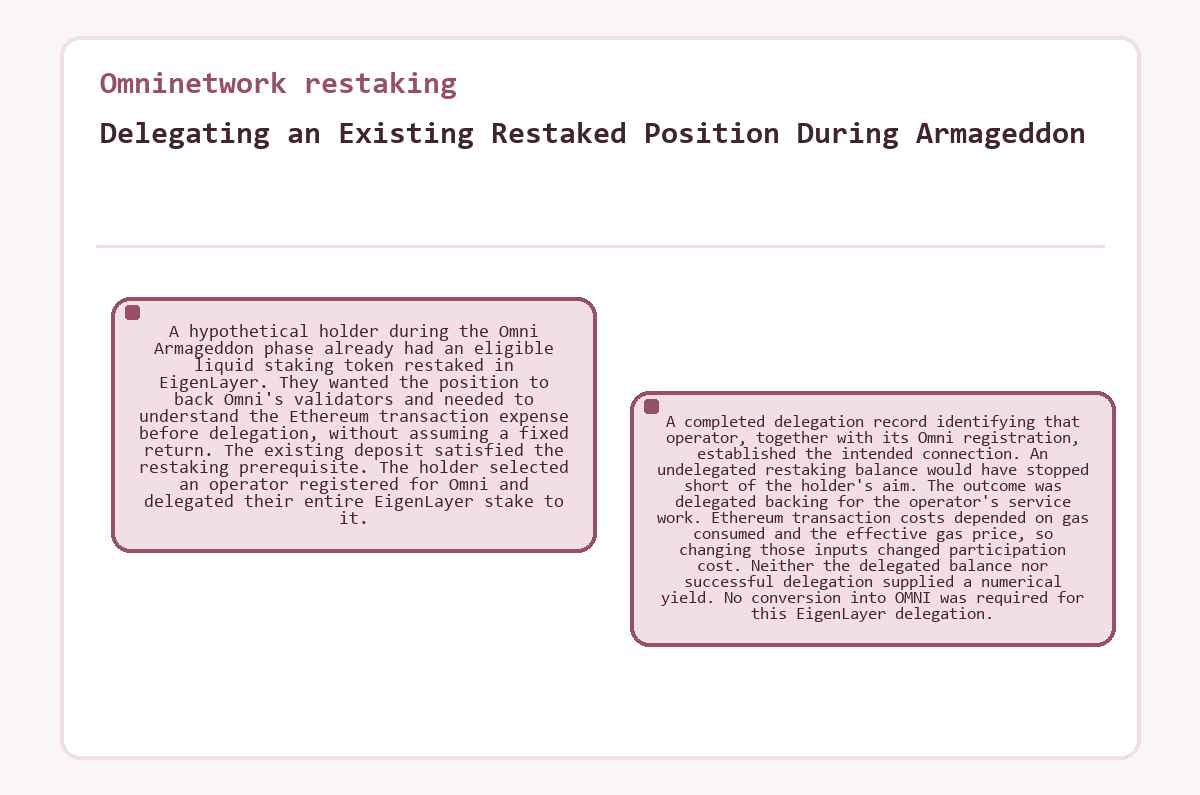
The existing deposit satisfied the restaking prerequisite. The holder selected an operator registered for Omni and delegated their entire EigenLayer stake to it. A completed delegation record identifying that operator, together with its Omni registration, established the intended connection. An undelegated restaking balance would have stopped short of the holder's aim.
The outcome was delegated backing for the operator's service work. Ethereum transaction costs depended on gas consumed and the effective gas price, so changing those inputs changed participation cost. Neither the delegated balance nor successful delegation supplied a numerical yield. No conversion into OMNI was required for this EigenLayer delegation.
Rewards, Gas and Slashing Followed Different Rules
A restaker's return depended on the reward arrangement and participation costs, while penalties depended on the applicable protocol release and operator commitments.
Launch-Stage Rewards
EigenLayer's April 9, 2024 mainnet release excluded in-protocol payments from AVSs to operators. An underlying Ethereum staking return and an additional AVS payment were separate sources of income. The availability of delegation did not itself specify a recurring Omni reward, an annual percentage or a payment schedule.
Ethereum Transaction Costs
Ethereum charged gas for contract execution, with ETH paying the transaction fee. Network demand affected gas prices, so the same restaking action could cost different amounts at different times. A transaction reverting during execution still incurred gas charges for the work it consumed.
Operator Sets and Penalties
Slashing meant a reduction of stake for violating service commitments. EigenLayer's April 2024 launch also excluded slashing. Eigen Labs' April 17, 2025 slashing announcement described operator sets and allocation of specific stake portions. Exposure required an operator to opt into a slashable set; it did not automatically cover every existing delegation. Those platform rules alone do not establish which Omni operators adopted a particular configuration. The operator's actual allocation remained material to the position's exposure.
SolverNet Deposits Addressed a Different Restaking Task
SolverNet addressed getting assets into a destination protocol across chains, while Omni's EigenLayer delegation addressed backing validator work. Omni's December 10, 2024 roadmap described a Symbiotic vault-deposit integration running on Devnet. That example concerned access to a restaking protocol from another chain. It did not make every deposit through SolverNet an allocation to Omni's EigenLayer operators. A deposit's destination protocol and its subsequent security commitments remained separate parts of the mechanism.
Native Staking Changed During the Nomina Rebrand
The August 12, 2025 rebrand announcement planned a pause in OMNI staking and said NOM staking would be unavailable at launch. Its later update reported the September 23, 2025 network upgrade had automatically migrated OMNI held on the Omni EVM, including staking rewards, to NOM. Those statements concerned native tokens and a specific network. They did not describe converting an external EigenLayer ETH position into NOM.
Omni Core's Closure Had a Chain-Specific Migration Scope
Nomina's February 23, 2026 closure announcement described a completed chain-state migration. Nomina reported shutting down Omni Core on February 17, 2026. It also reported automatically moving all wallet balances, staked positions and held assets on the chain to Ethereum as ERC-20 tokens. ERC-20 is Ethereum's fungible-token standard. The report covered state held on the retired blockchain.
An EigenLayer restaking position belonged to a separate contract system. The closure announcement did not establish an automatic withdrawal of external restaked ETH or liquid staking tokens. A migrated NOM balance on Ethereum therefore answered a different question from an EigenLayer withdrawal status. Native-token migration concerned the token holding; an EigenLayer exit concerned the restaking position and its applicable withdrawal rules.
Omninetwork restaking questions worth asking
Did Delegating to an Omni Operator Give It Custody of the Stake?
EigenLayer delegation was non-custodial, so the operator did not hold the delegated stake. The operator ran service software using the position's security backing. Delegation still involved contract and operator-performance dependencies; it did not mean withdrawing assets into a wallet.
Who Controlled Operator Selection for Omni Exposure Through a Liquid Restaking Token?
EigenLayer's April 2024 model placed delegation decisions with the liquid restaking protocol's decentralized autonomous organization (DAO). Each protocol's delegation readiness varied. Holding a liquid restaking token did not necessarily permit choosing an Omni operator directly, unlike managing an EigenLayer position through its delegation controls.
Could an April 2024 Omni Delegation Also Back Other AVSs?
Under EigenLayer's April 2024 design, an operator running multiple AVSs used its entire delegated stake to back those services. Delegation selected the operator, whose service choices affected that relationship. That arrangement differed from the later model allocating specific stake portions to operator sets.
Which Network Did the Omni Omega Delegation Tutorial Use?
The April 2, 2024 Omni Omega phase-two tutorial used the Holesky testnet. It described testnet ETH and a testnet staking-token route through EigenLayer. Those simulated balances and network settings concerned a test deployment, separate from the Armageddon mainnet restaking launch later that month.
Was the Genesis Airdrop a Recurring Omni Restaking Payment?
The Genesis airdrop was a separate token distribution with retroactive eligibility. Its April 10, 2024 announcement used an April 3, 2024 eligibility snapshot and restaker points for the EigenLayer restaker category. That historical allocation did not specify an annual restaking yield or confer eligibility through a later delegation.